

Introduction: What Are Options and Why Trade Them?
Options trading offers a powerful and flexible, yet undeniably complex, alternative to traditional stock ownership. For new investors, understanding the fundamental differences between buying a share of a company and trading an option contract is the first and most critical step toward navigating the market. These differences dictate the unique risks, rewards, and strategies that define the world of options.
Options are a type of financial derivative, meaning their value is derived from an underlying security, such as a stock. An option itself is a contract that gives the buyer the right, but not the obligation, to buy or sell the underlying stock at a predetermined price by a specific date. This is a stark contrast to stock trading, where purchasing a share represents acquiring a small piece of ownership in the underlying company.
It is also crucial to understand that options trading is a zero-sum game. Unlike stock investing where the overall market can grow, in the options market, one trader’s gain is directly another trader’s loss. For every contract buyer, there must be a seller, creating a direct competitive dynamic. This guide will provide a foundational, step-by-step pathway for beginners to understand and navigate the world of options, from core concepts to their first potential trades.
Part 1: The Absolute Basics - Core Concepts & Terminology
Mastering the specific vocabulary of options is the most critical first step for any aspiring trader. These terms are not just jargon; they are the essential building blocks for understanding every strategy, assessing risk, and making informed decisions. Without a firm grasp of this language, the mechanics of options trading remain inaccessible.
Call and Put Options
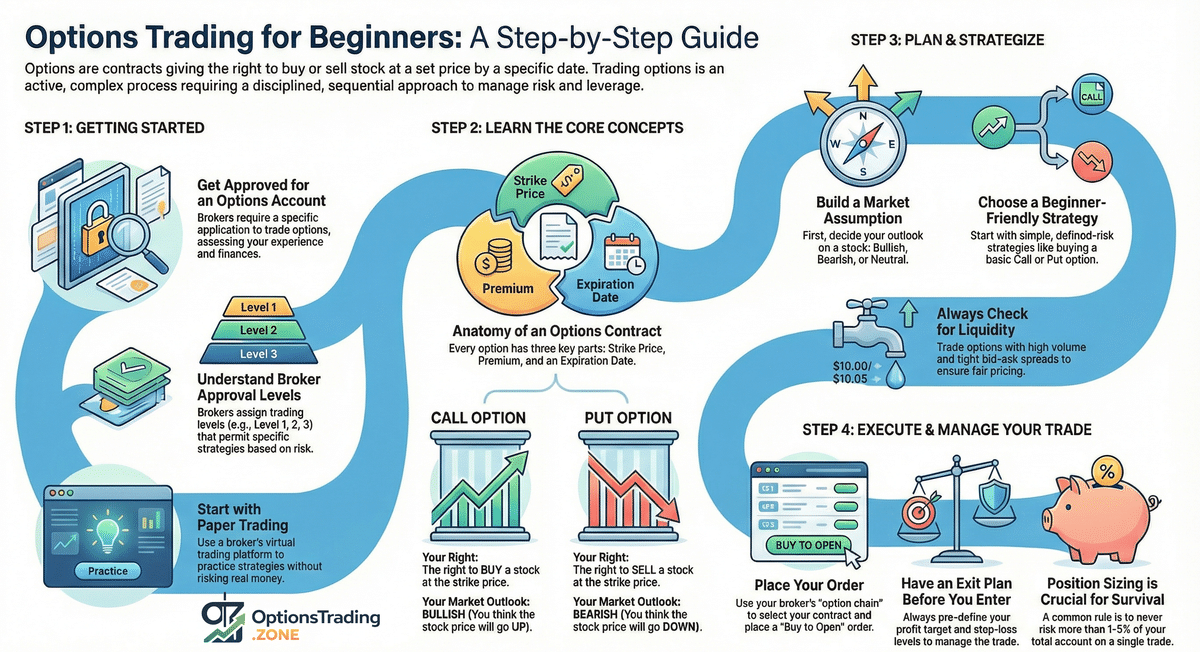
At the heart of options trading are two fundamental contract types: calls and puts. A call option grants the right to buy the underlying stock, while a put option grants the right to sell it.
Call Option
Put Option
The buyer has the right to buy the underlying security.
The buyer has the right to sell the underlying security.
You buy a call when you expect the price of the underlying asset will rise.
You buy a put when you expect the price of the underlying asset will drop.
Buyer and Seller (Writer)
Every options transaction involves two parties. The buyer is the individual who purchases the option contract and holds the right to exercise it. The seller, also known as the “writer,” is the individual who sells the contract and assumes the obligation to fulfill its terms if the buyer chooses to exercise it. Think of the option seller as being similar to an insurance company. The seller collects a premium (the price of the option) from the buyer in exchange for taking on the risk of a specific event happening-in this case, the stock moving beyond the strike price. By selling or “writing” an option, the seller effectively creates a security that did not exist before.
Strike Price
The strike price is the pre-set price at which the holder of the option can buy (for a call) or sell (for a put) the underlying stock. Strike prices are generally available in intervals of $0.50, $1, $2.50, or $5, depending on the price of the stock.
Expiration Date
Every option contract has a limited lifespan and expires on a specific date, known as the expiration date. If the option is not exercised by this date, the contract becomes void. Standard monthly options typically expire on the third Friday of the month, while weekly options are also available that expire on the other Fridays of the month.
Premium
The premium is the price of the option contract that the buyer pays to the seller (writer). Since a single stock option contract typically represents 100 shares of the underlying stock, the total cost to the buyer is the premium multiplied by 100. For example, a contract with a premium of $0.55 would cost the buyer 55(0.55 x 100). This premium is the absolute maximum amount of money the option buyer can lose, which is a key strategic advantage of buying options compared to owning stock.
In-the-Money (ITM), At-the-Money (ATM), and Out-of-the-Money (OTM)
The relationship between the option’s strike price and the underlying stock’s current market price determines whether the option is in-the-money, at-the-money, or out-of-the-money.
-
In-the-Money (ITM):
-
A call option is ITM when its strike price is below the stock’s market price.
-
A put option is ITM when its strike price is above the stock’s market price.
-
At-the-Money (ATM): An option is ATM when its strike price is the same as the stock’s current market price.
-
Out-of-the-Money (OTM):
-
A call option is OTM when its strike price is above the stock’s market price.
-
A put option is OTM when its strike price is below the stock’s market price.
American vs. European Style Options
Options contracts also come in two different styles that dictate when they can be exercised.
-
American-style options can be exercised at any time between the purchase date and the expiration date.
-
European-style options can only be exercised on the expiration date itself.
All exchange-traded stock options are American style.
With these fundamental terms defined, we can now explore the factors that influence an option’s value and the risks associated with it.
Part 2: Understanding Option Value & Risk - The Greeks
To move beyond basic terminology, traders use a set of calculations known as “the Greeks” to measure the various risk factors that influence an option’s price. While these values are theoretical, a basic understanding of what they represent is essential for making informed trading decisions and managing the risks inherent in any options position.
The five main Greeks provide a snapshot of an option’s sensitivity to different market forces:
-
Delta: Measures how much an option’s price is expected to change for every $1 move in the underlying stock.
-
Gamma: Measures the rate of change in an option’s Delta, acting like an acceleration metric for price sensitivity.
-
Theta: Measures the rate of price decline in an option due to the passage of time, a concept known as time decay.
-
Vega: Measures an option’s sensitivity to changes in the implied volatility of the underlying stock.
-
Rho: Measures an option’s sensitivity to changes in interest rates.
A Closer Look at Theta (Time Decay)
Of all the Greeks, Theta is one of the most important concepts for a new trader to grasp. For anyone buying a call or put option (a “long” position), Theta is always negative. This means that, all other factors being equal, the option loses a small amount of value every single day. This erosion of value is known as time decay. The rate of this decay is not linear; it accelerates significantly as the option’s expiration date approaches, making time an enemy of the option buyer. You can visualize Theta as a melting ice cube. It melts slowly at first, but as it gets smaller (closer to expiration), the rate of melting speeds up until nothing is left.
Understanding these theoretical risk factors provides a necessary foundation before moving from theory to practice and taking the first steps to begin trading.
Part 3: Your Step-by-Step Guide to Getting Started
Before you can place your first trade, you must complete a formal process to open and fund a brokerage account and receive specific approval for options trading. This multi-step process is a crucial safeguard, designed to protect both you and the brokerage from the significant risks associated with options.
Step 1: Choose and Open a Brokerage Account
Opening a brokerage account is a straightforward online process, much like opening a bank account, and typically takes only 5 to 10 minutes to complete. You will need to provide your Social Security Number (SSN) and other basic personal information to get set up.
When selecting a broker for options, two key considerations are low-cost options trading and the availability of solid educational support. Many platforms offer commission-free trading, but fees per contract can vary. Several well-regarded brokers that offer options trading include:
| • Fidelity | • Charles Schwab | • tastytrade |
|---|---|---|
| • Interactive Brokers | • E*TRADE | • SoFi |
| • Robinhood | • Webull | Step 2: Get Approved for Options Trading |
Because of the inherent risks, trading options requires specific approval from your brokerage. This approval is granted in tiered levels, with each subsequent level permitting more complex and higher-risk strategies. While the exact structure can vary-with some brokers offering a simpler two- or three-level system-most traditional brokerages use a four-level system to grant approval.
-
Level 1: Covered Calls and Cash-Secured Puts. This is the lowest-risk level, allowing you to sell options that are “covered” by either owning the underlying stock (for calls) or setting aside enough cash to buy it (for puts).
-
Level 2: Buying Call and Put Options. This level allows you to purchase options. The risk is considered defined because your maximum potential loss is capped at the premium you paid for the contract.
-
Level 3: Options Spreads. A more complex level that involves trading multiple option contracts simultaneously (known as “legs”). These strategies often require trading on margin, which means borrowing from the broker.
-
Level 4: Naked Calls and Puts. This is the highest and riskiest level, allowing you to sell unhedged or “naked” options. A naked call, in particular, carries the potential for unlimited losses.
Brokers assign these levels based on an application that assesses your trading experience, annual income, net worth, and stated investment objectives.
Step 3: Fund Your Account
Once your account is open and approved, the final step is to fund it. The most common method is linking an existing bank account to allow for electronic transfers. While some brokers may have deposit minimums for certain features, many have no minimum requirement to open and fund a basic account.
With your account set up, approved, and funded, you are now ready to explore the first and most fundamental strategies available to a new options trader.
Part 4: Foundational Strategies for Beginners
New traders should begin with the simplest, most risk-defined strategies available. The following approaches correspond directly to the initial approval levels (Levels 1 and 2) granted by most brokerages. Mastering these four strategies provides a solid foundation for understanding market direction, managing risk, and learning the practical mechanics of options trading.
Strategy 1: Buying a Call Option (Long Call)
This is a straightforward bullish strategy. You buy a call option when you expect the price of the underlying stock to rise significantly before the option’s expiration date. Your maximum potential loss is strictly limited to the premium you paid for the contract, making it a defined-risk trade.
Strategy 2: Buying a Put Option (Long Put)
This is the opposite of a long call and is a bearish strategy. You buy a put option when you expect the underlying stock’s price to fall significantly. Just like with a long call, the maximum risk is defined and limited to the premium paid for the option.
Strategy 3: Selling a Covered Call
A covered call is an income-generating strategy. It involves selling (writing) a call option while you simultaneously own at least 100 shares of the underlying stock. This strategy is most often used by investors who are neutral to slightly bullish on a stock they already own and wish to generate additional income from their shares. You collect the premium from selling the call as income. The primary risk is that if the stock price rises above the strike price, your shares may be “called away,” meaning you will be obligated to sell them at the strike price.
Strategy 4: Selling a Cash-Secured Put
This is another income-focused strategy that can also be used to acquire stock. It involves selling (writing) a put option while ensuring you have enough cash in your account to purchase 100 shares of the stock at the strike price if you are assigned. Traders use this to either collect the premium as profit or to potentially buy a stock they like at a price lower than its current market value.
Once you’ve executed one of these strategies, the next step is to understand the different ways a trade can be managed or brought to its conclusion.
Part 5: Managing Your Trades - The Option Lifecycle
Entering an options trade is only the beginning of the process. The strategic importance of managing a position cannot be overstated. An effective trader must know the available actions-whether to close a position early, adjust it to changing market conditions, or hold it through expiration-and understand the appropriate time to use each one.

-
Closing a Position: The most common way to exit a trade before expiration is to execute an offsetting transaction. If you bought an option, you can close the position by selling that same option. If you sold (wrote) an option, you can close it by buying it back. This allows you to lock in a profit or cut a loss without waiting for the contract to expire.
-
Rolling a Position: Rolling is the simultaneous act of closing an existing option position and opening a new one on the same underlying asset but with a different strike price, a later expiration date, or both. Traders use this technique to give a trade more time to become profitable or to adjust their position in response to significant market movements.
-
Exercising and Assignment: Exercising is the act by which the option buyer invokes their right to buy or sell the underlying shares at the strike price. When a buyer exercises their option, a seller of that same option is randomly selected by their broker to fulfill the obligation. This process is called assignment. The assigned seller must then either sell their shares (for a call) or buy shares (for a put) at the strike price.
-
For a new seller, receiving an assignment notice from your broker can be jarring if unexpected. It is not a penalty, but a routine fulfillment of your contractual obligation. Understanding that assignment is a core mechanic of selling options-and having a plan for either delivering your shares (for a covered call) or buying the shares (for a cash-secured put)-is critical to managing your positions effectively.
-
Expiration: If an option is out-of-the-money (OTM) when it reaches its expiration date, it expires worthless. In this scenario, the buyer loses the entire premium they paid, and that premium becomes the seller’s maximum profit.
Properly managing a trade is a key skill, but equally important is recognizing and avoiding the common mistakes that can derail a beginner’s trading plan.
Part 6: Avoiding Common Pitfalls
Success in options trading requires a high degree of discipline and awareness. Learning to avoid the most frequent errors made by new traders is just as critical as learning winning strategies. Recognizing these pitfalls can help you protect your capital and build a more sustainable approach to trading.
-
Lack of a Trading Strategy Jumping into trades without a solid plan leads to impulsive decisions driven by emotion or market noise. Before entering any trade, you must define how you will identify opportunities and, just as importantly, establish a clear exit strategy for both winning and losing scenarios.
-
Neglecting Diversification Concentrating all your capital into a single strategy or position is highly risky. A more prudent approach is to use a variety of strategies and spread your capital across multiple positions. This diversification can help cushion your portfolio against unexpected losses in any single trade.
-
Lacking Discipline A common trap for new traders is selling winning positions too early out of fear and holding onto losing positions for too long in the hope of a turnaround. The key to avoiding this is to create a trading plan with clear rules for exiting trades and having the discipline to stick to it, even during emotional market swings.
-
Using Margin Carelessly Trading on margin (borrowed funds from your broker) amplifies both potential profits and potential losses. It significantly increases your risk profile. You should only ever trade on margin with funds that you can truly afford to lose.
-
Trading Illiquid Options Liquidity refers to the ease with which you can enter and exit a trade at a fair price, and it is a critical factor often overlooked by new traders. You can often identify illiquid options by a wide gap, or ‘spread,’ between the bid price (the highest price a buyer will pay) and the ask price (the lowest price a seller will accept). Trading these can make it difficult to enter or exit positions at favorable prices, leading to unexpected losses, especially in fast-moving markets.
-
Failing to Understand the Greeks Ignoring the Greeks is like sailing without a compass. As discussed in Part 2, these metrics are your primary tools for understanding a position’s risk exposure in real-time. Without a basic grasp of how time decay (Theta) erodes your option’s value daily or how a spike in market fear (Vega) can inflate its price, you are trading blindly and cannot make informed decisions about when to enter, hold, or exit a position.
Ignoring Volatility Volatility is a critical component of an option’s price. You must consider whether an option seems fairly priced based on its current implied volatility compared to its historical levels. Ignoring this factor means you may be overpaying for options without realizing it.
Beyond avoiding these trading mistakes, new traders must also be aware of another critical, often-overlooked area: taxes.
Part 7: Understanding the Tax Implications
Profits generated from options trading are considered income and are subject to taxation. For traders, it is strategically important to understand the rules surrounding capital gains, as the length of time you hold a position can significantly impact your final tax bill.
Capital Gains Explained
A capital gain is the profit you realize from selling an investment for more than its purchase price (its “cost basis”). These tax rules generally apply to assets held in standard taxable brokerage accounts. They do not apply to investments held within tax-advantaged accounts, such as IRAs or 401(k) s, where taxes are typically deferred until you take withdrawals.
Short-Term vs. Long-Term Capital Gains
The amount of tax you pay on a capital gain depends on how long you held the investment. There are two categories, each with different tax implications.
Short-Term Capital Gains
Long-Term Capital Gains
Holding Period: One year or less.
Holding Period: Longer than one year.
Tax Rate: Taxed at your ordinary income tax rates, which are the same rates that apply to your wages or salary.
Tax Rate: Taxed at more favorable long-term rates, which are typically 0%, 15%, or 20% depending on your income level.
Special Tax Rules for Certain Options
It is important to note that some derivatives are subject to unique tax treatment. For example, some derivatives, such as options on broad-based indexes and options on futures, fall under a special ‘Section 1256’ designation by the IRS. These contracts follow the 60/40 rule, meaning that 60% of any gain is taxed at the favorable long-term rate and 40% is taxed at the short-term rate, regardless of how long the position was actually held.
With a foundational understanding of the options market, from core concepts to tax implications, we can now summarize the key takeaways for your trading journey.
Conclusion: Your Journey in Options Trading
Options trading offers investors a remarkable degree of strategic flexibility and financial leverage, but these benefits come with significant complexity and risk. Success in this arena is not a matter of luck; it is built on a firm commitment to education, disciplined execution, and rigorous risk management.
For the beginner, the path forward should be methodical and cautious. The key steps are to first learn the fundamental concepts and terminology that govern the market. With that knowledge, you can develop a solid trading plan, begin with basic and risk-defined strategies, and remain acutely aware of the common mistakes that can erode capital. Finally, understanding your tax obligations ensures that you can properly account for your trading activity.
Ultimately, the most reliable foundation for a successful trading journey is a dedication to continuous learning. The markets are always evolving, and the traders who thrive are those who evolve with them.


-in-options-trading-what-it-is-and-why-it-matters_1.w960.webp)